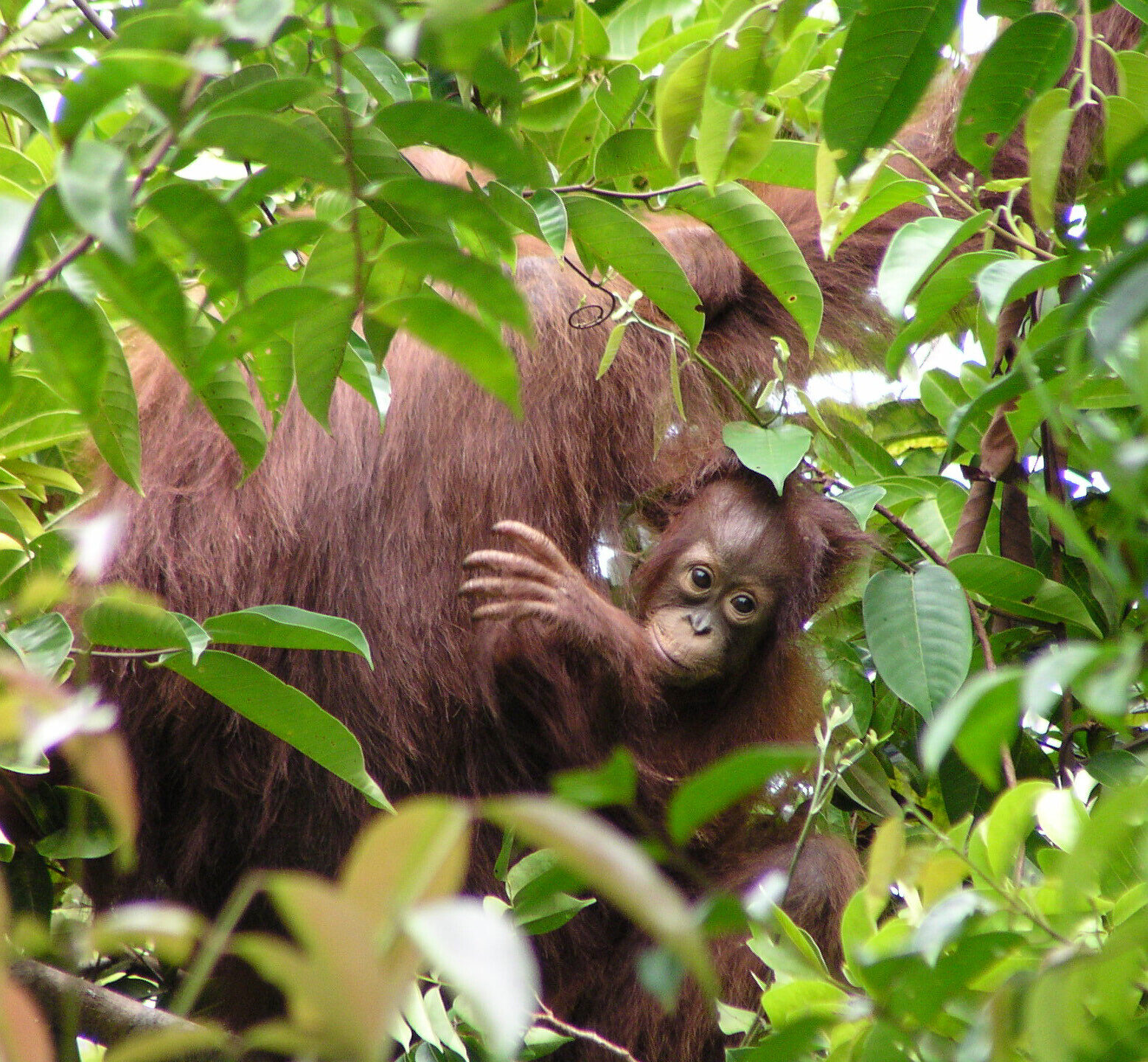
Bornean Orangutans (Pongo pygmaeus) are among our closest living relatives, sharing around 97% of their DNA with humans. Researchers have documented remarkable problem-solving abilities in wild orangutans, from using simple tools to access food to adapting their behaviour to changing environmental conditions. High in the forests of Borneo, orangutans spend their lives in the canopy, where our partner Hutan is working to preserve the forest, supported by our summer appeal.
Life in the Trees
Moving carefully through the treetops, they search for fruit like figs and mango and their favourite, durian fruit, using leaves as gloves to protect their hands as they break into its spiky shell. In the trees, they build sleeping nests from branches and leaves, and raise their young in one of the longest periods of parental care found anywhere in the animal kingdom.
What makes orangutans particularly vulnerable, however, is the pace at which they reproduce. Female orangutans typically give birth only once every seven to nine years, and they spend years teaching and caring for a single offspring before raising another. During this time, young orangutans will learn all the skills essential for survival from their mothers. The mothers teach their young where they can find food, how to navigate the tangled forest canopy, and how to build the nests that they will use throughout their lives. Because orangutans reproduce so slowly, populations struggle to recover when individuals are lost. Even small declines can have long-term consequences.
The Disappearing Forest
This challenge is especially evident in the Kinabatangan region of Malaysian Borneo. Once connected by vast areas of lowland rainforest, so much of the landscape has been fragmented over the past few decades. The patches of forest that remain intact are often separated by agricultural developments and roads cutting through them, making it difficult for much wildlife to move between habitats. For orangutans, habitat fragmentation like this can mean their access to food is made more difficult and there are fewer opportunities to find mates, it also increased the risk of conflict with people. Some populations can become so isolated that they become vulnerable to local extinction.
Hope with Hutan
For more than two decades, our partner Hutan, based in Sabah, has been working tirelessly to tackle these challenges. Through habitat restoration, wildlife monitoring, and efforts to reconnect fragmented forests, Hutan is helping to secure a future for orangutans and the many other species that share their habitat. These efforts are already making a difference. Forest corridors help wildlife move between the isolated habitat patches, while restored areas give degraded land the chance to recover in peace.
But protecting orangutans is also about so much more than safeguarding a single species, as fascinating as they are. As large seed dispersers, they play an important role in maintaining healthy forests. The very forests they depend on also support countless other species and provide benefits for local communities from regulating flood waters to attracting wildlife tourism.
By supporting our appeal for Hutan, you can help protect and restore the forests that orangutans rely on, ensuring that these remarkable apes continue to thrive in the wild for generations to come.