
Mission
Fundación Rewilding Argentina (FRA) is dedicated to promoting the complete recovery of Argentina’s ecosystems through active species’ reintroductions.
Our partner works closely with local communities and provincial governments to develop sustainable ecotourism packages that promote coexistence between people and wildlife. Their vision is one of thriving complete ecosystems with healthy populations of all native species, including large predators such as Puma (Puma concolor) and Jaguar (Panthera onca).
HISTORY
FRA was founded in 2010 by Argentinian conservationists from its parent organisation Tompkins Conservation.
Since being founded, FRA have created or expanded 10 national or provincial parks across Argentina, with 1 million hectares protected on land and 100,000 km² at sea. To restore these ecosystems, they have reintroduced Jaguars, Pampas Deer (Ozotoceros bezoarticus), and Scarlet Macaws (Ara macao), and successfully carried out the world’s first reintroduction of Giant Otters (Pteronura brasiliensis).
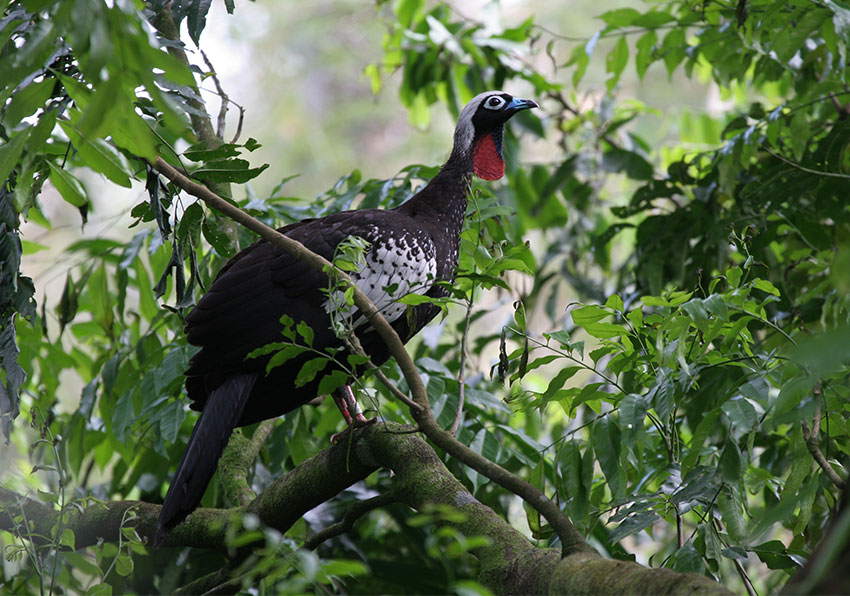
Black-fronted Piping Guan. Credit: ©Lee Dingain.
Partnership with WLT
In 2025, World Land Trust’s (WLT’s) first project with FRA was to secure 164 hectares (405 acres) of precious Atlantic Forest habitat in northeast Argentina’s Andresito Peninsula. This marks Rewilding Argentina’s first land purchase in the area, with 50% of the funds provided by WLT’s supporters.
This site lies within the wider Atlantic Forest, one of the richest ecosystems on the planet. Stretching from Brazil into Paraguay and Argentina, it is as biodiverse as the Amazon – home to around 20,000 plant species (40% endemic) and 298 mammal species (30% endemic), alongside a remarkable diversity of birds, reptiles, and amphibians.
Initial biodiversity surveys of the newly protected site have identified 18 threatened species, including the Critically Endangered Paraná Pine (Araucaria angustifolia) which, despite its name, is not a pine at all, and the Endangered Black-fronted Piping Guan (Pipile jacutinga).

Other activities
• The reintroduction of Jaguars to the Corrientes Province, establishing an initial population of 18 wild individuals, with births in the wild for the first time in over 70 years.
• The reintroduction of the Pampas Deer to the Corrientes Province in 2006. By 2021, this region had one of the highest concentrations of Pampas Deer in Argentina, at 300 individuals.
• The first reintroduction of Giant Otters to Argentina, where no wild or captive individuals were left, by collaboration with the IUCN and European zoos.
• The promotion of wildlife-based tourism in communities around the parks, such as guided walks, kayaks, wildlife watching, and local cuisine and crafts.
• Setting up the FRA Marine Programme in 2017 to protect the marine and coastal ecosystem and species of Argentina.
• Promoting the creation of the first National Marine Parks in Argentina between 2017 and 2022, including the parks Yaganes and Namuncurá-Banco Burdwood II.
• Safeguarding the wildlife-rich waters of Tierra del Fuego’s Beagle Channel from salmon fishing.
• Conducting environmental education in schools and communities around the reserves to encourage coexistence between people and wildlife.
• Partnering with scientific institutions to monitor wildlife; for example, using camera traps and GPS technology to better understand the feeding locations of Imperial Cormorants’ (Leucocarbo atriceps) and Northern Giant Petrels (Macronectes halli).
• The monitoring of wildlife within the reserves using camera traps and GPS technology.