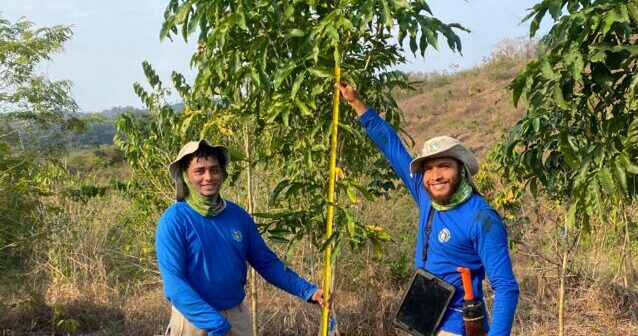
Buenos Dias! Good morning to all my friends of World Land Trust.Marcelo Ortega, Restoration Coordinator
My name is Marcelo Ortega and I am the restoration coordinator at the Fundación Proyecto Tití (FPT) Los Titíes de San Juan Reserve in Colombia. I would like to take you on a tour with my team and show you what a day as an FPT ranger looks like.
Acompáñenos — join us — on a tour of the reserve where we are venturing into the great tropical dry forest! We begin at the Luis Soto Interpretation Centre. We usually hold meetings and gatherings with visitors and donors here to show them the large map that shows all the vegetation coverage of the reserve and all the forest areas we are protecting. From here we will head into the forest and make our way to the Yepes Plantation area where we are working on an intensive restoration strategy.
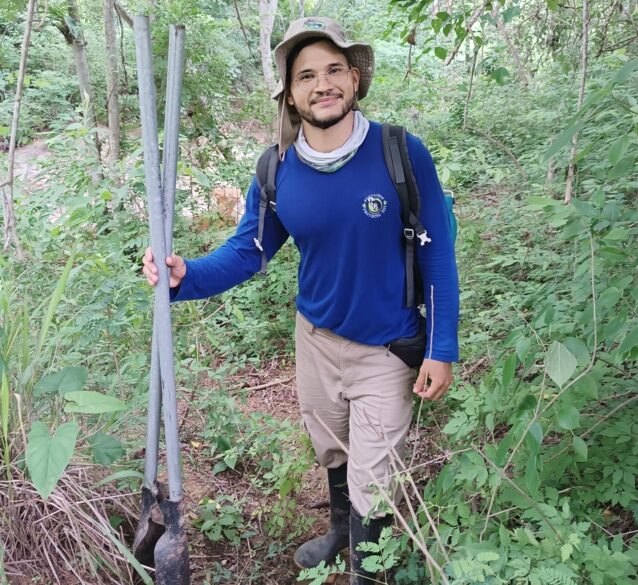
Restoration Coordinator Marcelo. Credit: Fundación Proyecto Tití
As we begin along the trail, we can see and hear that some pollinators are taking advantage of the blooming flowers, and many trees are in their fruiting season. This attracts a great deal of seed-dispersing animals like birds, bats, and rodents. In turn, these animals will attract small reptiles, snakes, and lizards. In the forest, there is so much interaction among the various organisms, the ecosystem is always at work. As a ranger, my daily work involves ensuring the protection of various trees. Many of the trees are marked with colour-coded numbers, such as the great Camajón tree and, next to it, the Tutomo tree. These trees are marked as being of significant biological importance because of their consistent fruit production from which we obtain seeds to propagate the species in our nursery.
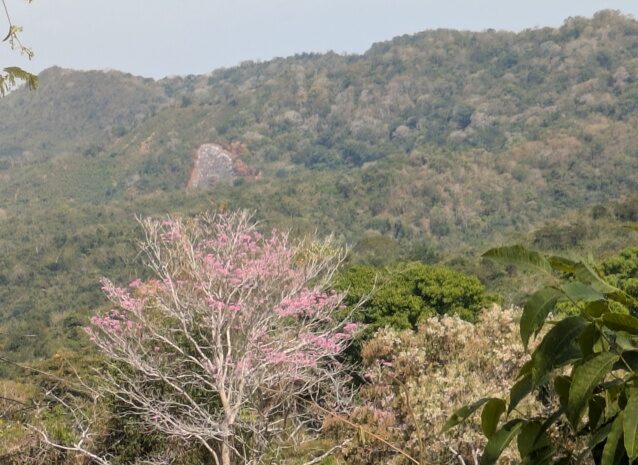
Los Titíes de San Juan Reserve. Credit: Fundación Proyecto Tití
The Yepes plantation is a 50-minute walk away and, as we venture further into the Great Tropical Dry Forest, we can observe how the vegetation cover changes as we approach what is known as a riparian forest or a gallery forest. Another of our tasks as rangers is the identification of parent trees. One of these is the large Mamon de María tree which serves as a refuge for the Cotton-top Tamarin. We collect the seedlings of this tree to plant and propagate and expand the forest. With the increase in rain, our daily work becomes a little more difficult as trails become clogged with thick mud, making for some interesting working conditions!
After a long walk through intense heat, we reach our destination. Here, we are in the strategic centre of the Yepes plantation, where we gather the saplings from the nursery ready for planting and meet with field assistant Aldair Luna, another of our wonderful rangers.
Each day, we fall more in love with what we do, helping these saplings to adapt to the forest and benefit our beloved Cotton-top Tamarin.Aldair Luna, Field Assistant
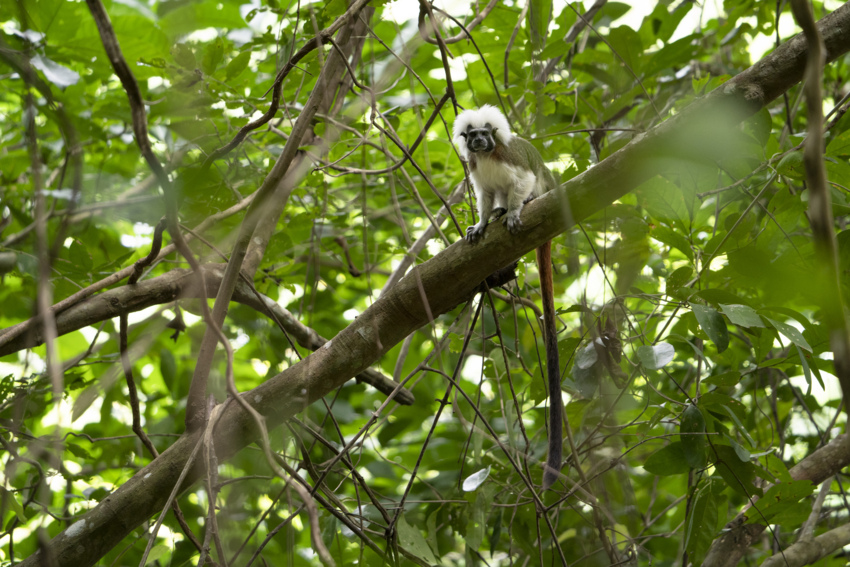
The Critically Endangered Cotton-top Tamarin (Saguinus oedipus). Credit: Frederico Pardo
Hola, my name is Aldair Luna and I have been a field assistant for six years, working with this wonderful team, doing this amazing work. Each day, we fall more in love with what we do, helping these saplings to adapt to the forest and benefit our beloved Cotton-top Tamarin.
One of my duties is to identify areas of coverage for where we will plant. Before each planting, we conduct a thorough coverage study to determine what strategy we will use- it’s not just planting for the sake of planting. This was a highly degraded area used for livestock grazing for a long time, and we are now undertaking intensive restoration to provide food and shelter for not only the Cotton-top Tamarin but also for all other animals of the forest. The future forest will be wonderful, and it will be amazing to walk through this entire area.
Thank-you very much for your support and help, without you, this would not be possible.
Support Rangers Today
World Land Trust’s Keepers of the Wild are rangers working on the front line of conservation. They safeguard some of the world’s most threatened species and the incredible habitats in which they are found.