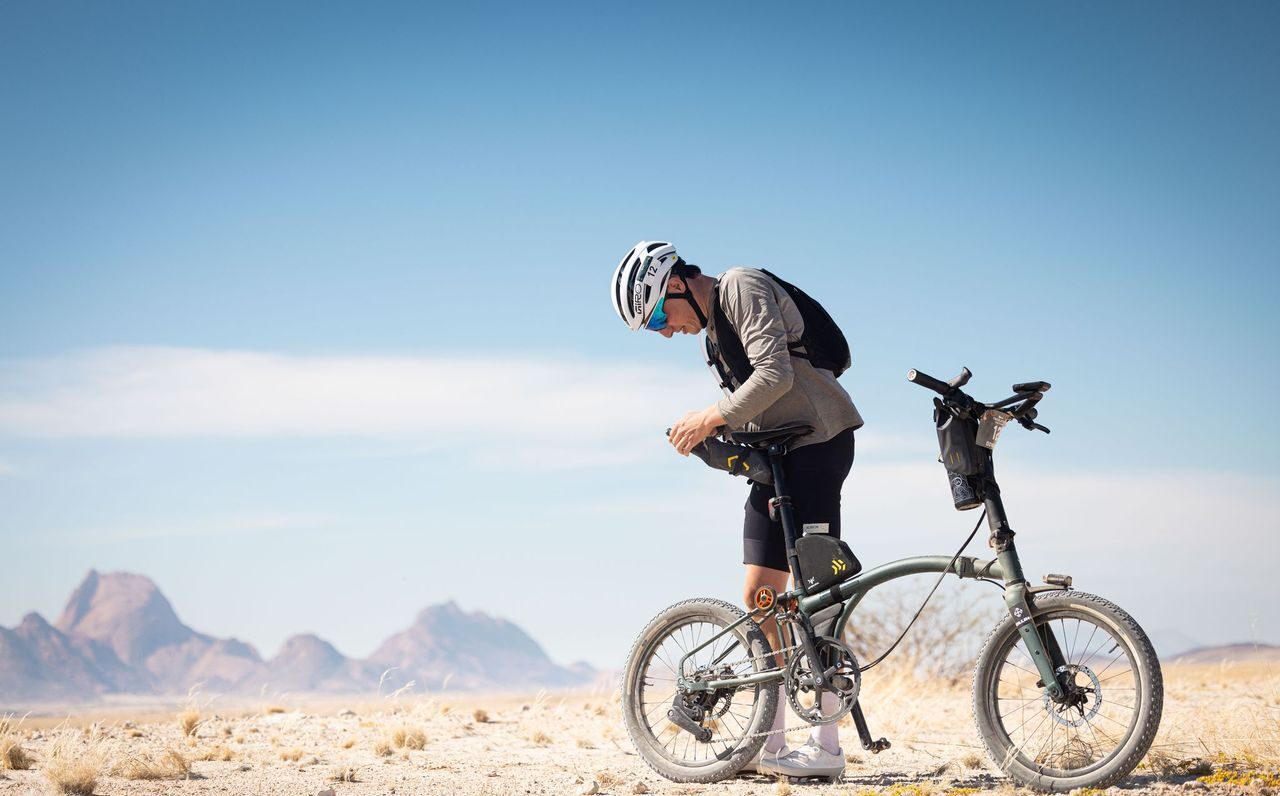
In June 2026, photographer Andy Donohoe took on an extraordinary challenge to raise funds for World Land Trust (WLT): cycling nearly 3,000 kilometres across southern Africa, from Namibia’s Atlantic coast to the Indian Ocean.
Ahead lay relentless desert roads, deep sand, punishing climbs and immense open landscapes. As if the journey were not unusual enough, Andy undertook it on a folding bicycle provided by WLT Corporate Supporter Brompton Bikes. With this bicycle, part of Brompton’s G-Line range, Andy joined 34 other cyclists on this epic journey.
It didn’t take long for the enormity of the challenge to hit.
At the start, it was like pedalling through treacle. My legs were cooked. By day three, I genuinely had a feeling of not being able to do this.
Wildlife, fences, and co-existence
For Andy, this journey soon became much more than an endurance challenge.
Travelling at bicycle speed gave him an unusually intimate view of the landscapes he was riding to help protect. One of his most magical encounters came almost immediately. On just the second day, riding alone through the bush, Andy suddenly found himself cycling alongside a giraffe and her calf.
Over the weeks that followed there were herds of Plains Zebra (Equus quagga), Southern White Rhino (Ceratotherium simum simum), and countless reminders that he was travelling through some of southern Africa’s greatest wildlife landscapes.
Yet something was missing.
I definitely didn’t see as much wildlife as I expected. In South Africa especially, and Botswana as well, I was struck by how much is kept behind fences. It was a real wow moment for me.
The Elephant Highway
On Botswana’s Trans-Kalahari Highway, Andy rode a stretch known as the Elephant Highway. Enormous footprints marked where African Elephants had crossed the road, while nearby villages told another side of the story.
“They had built these huge circles of wooden spikes to stop African Elephants trampling their crops. It was a real eye-opener.”
For thousands of kilometres, Andy was seeing first-hand one of conservation’s greatest challenges: how can wildlife move through landscapes increasingly divided by roads, farms, settlements and fences, while people are able to live safely alongside it?
By the time he reached the end of his journey, that question had taken on a new significance.
Where the fences are coming down
After almost 3,000 kilometres in the saddle, Andy’s trans-African adventure ended at Wild Tomorrow’s Ukuwela Reserve on South Africa’s Elephant Coast. And after weeks of seeing fragmented landscapes, what he discovered there offered a glimpse of something very different.
“Yesterday we arrived at the Wild Tomorrow reserve, the Ukuwela Reserve. And we just had the most incredible experience.”
Joining Wild Tomorrow’s Greg and Chantelle on a game drive, Andy swapped two wheels for four and discovered a landscape alive at every scale – from towering Lebombo Wattle (Newtonia hildebrandtii) trees to tiny termites. But it was the bigger picture that really struck him.
Wild Tomorrow is working to secure and reconnect parcels of threatened habitat, allowing fences to come down and wildlife to move once again across a much larger, connected landscape. And nature is already responding.
“They’ve already got different animals coming into their land that are coming over or under the fence. Leopards and hyenas that were never put there.” The significance of that was hard to miss after everything Andy had seen from the saddle.
“If they can secure a few more parcels of land, they can connect one huge protected area to another. It was amazing to learn about.”
A journey that had begun as an extraordinary physical challenge ended with a powerful demonstration of why connected habitat matters. For Andy, after 23 days crossing a continent on two very small wheels, it was quite a place to finally stop pedalling.
——–
You can now watch Andy’s extraordinary journey – and the landscapes, wildlife and people he encountered along the way – in Ukuwela, Brompton’s new film exploring his ride across southern Africa and Wild Tomorrow’s work to reconnect threatened habitat on South Africa’s Elephant Coast.
Protect wildlife today
In South Africa, we are raising funds right now to strengthen the wildlife corridor Andy saw on his journey. Donate today to reconnect vitally important habitat before it’s too late.