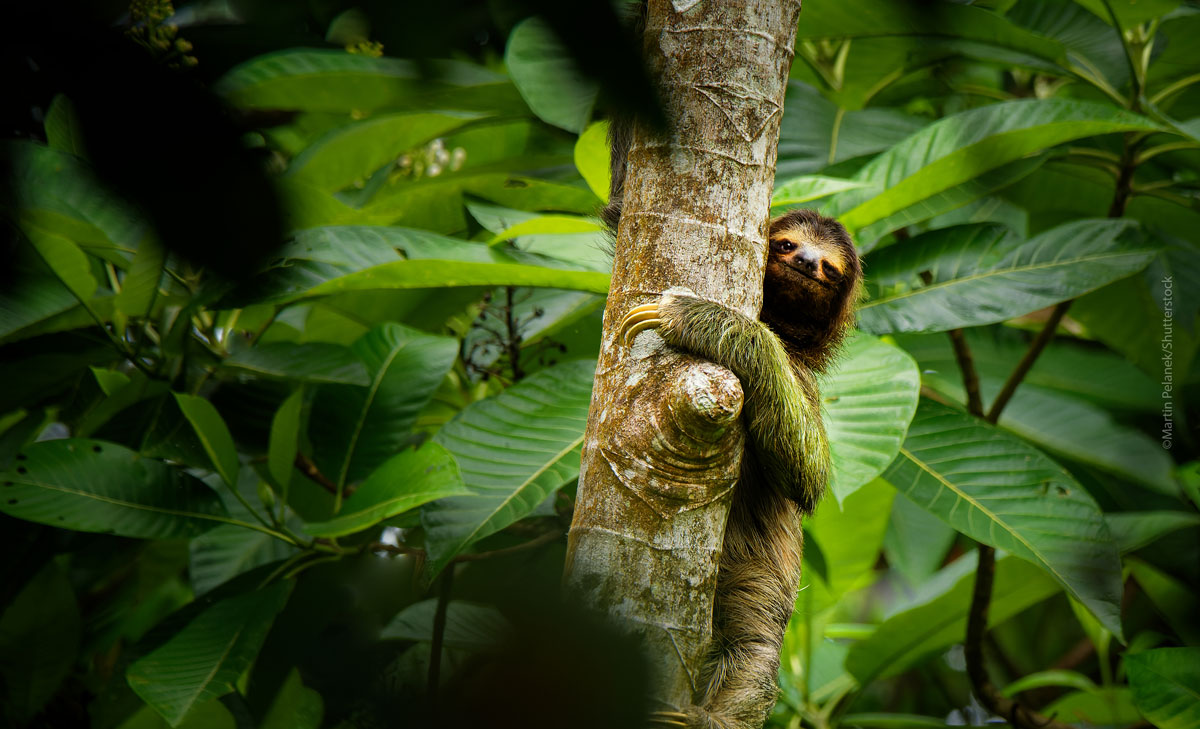
High in the canopy of Reserva Ecológica de Guapiaçu (REGUA), the movement of the Brown-throated Sloth (Bradypus variegatus) is almost imperceptible. Its shape shifts slowly among the leaves, limbs draped over a branch, peacefully minding its unhurried business as the busy forest hums all around.
Sloths are often defined by their slowness, but this is no accident. Moving at just a few metres per hour, and resting for much of the day, they survive on a diet of leaves that would not sustain most mammals.
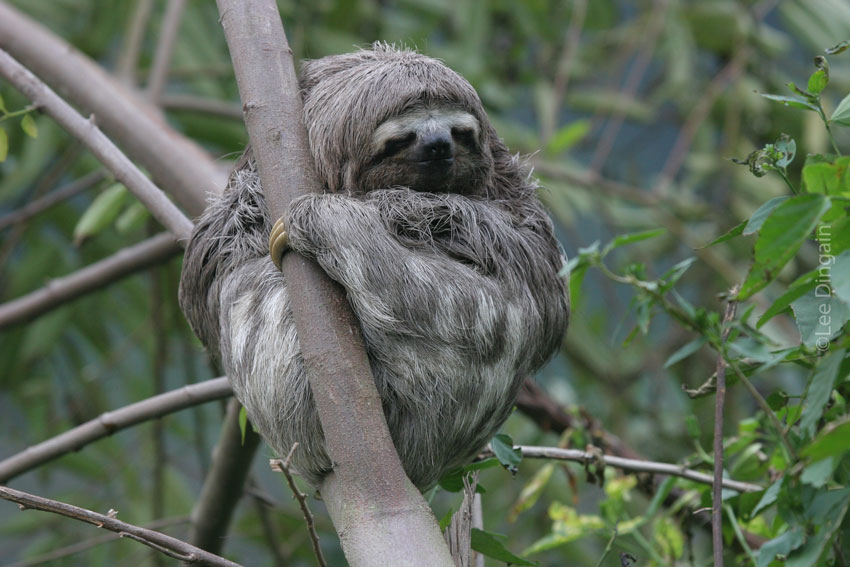
A resting Brown-throated Sloth at REGUA, Brazil. Credit: ©Lee Dingain.
They have a remarkably slow metabolism and a digestive system that can take weeks to process a single meal, and so their entire lives and behaviours are built around conserving energy. As they spend much of their time hanging upside down, their organs are anchored in place to allow them to breathe comfortably while suspended. Their slow pace makes them vulnerable when they descend to the ground something they do only rarely, often just once a week. In those moments, Sloths are exposed to predators such as the Puma (Puma concolor). Because of this, most of a sloth’s time is spent high in the canopy, even birth and mating take place among the branches.
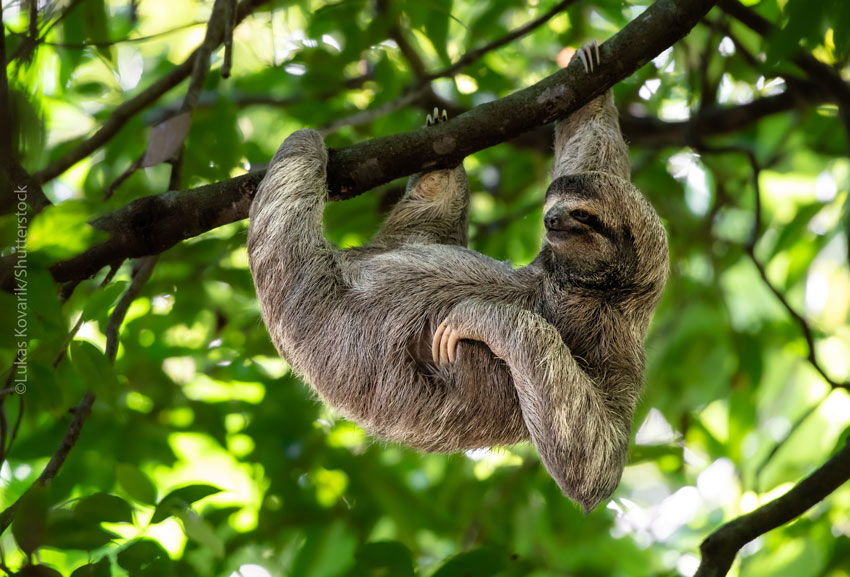
The Brown-throated Sloth is rarely found on the ground, spending most of its time in the trees. Credit: ©Lucas Koravik.
These peaceful mammals’ survival depends on connected forest. Sloths cannot leap gaps or travel quickly across open ground. Fragmented landscapes turn trees into isolated islands, cutting them off from food, shelter, and mates. Increasingly, threats such as deforestation, road expansion, and power lines are making movement through the landscape more dangerous, and in some cases impossible. By reconnecting habitats and allowing the canopy to recover, REGUA is rebuilding the continuous forest that species like the sloth depend on.
The result is a landscape where wildlife can move and thrive once again. Today, REGUA supports an extraordinary diversity of life, with over 490 bird species, 73 species of amphibians, 430 species of butterfly, and 61 mammal species, the reserve is a wellspring of wildlife with the sloth quietly inhabiting the spaces above them all.

 Help us raise £197,260 for our partner Reserva Ecológica de Guapiaçu (REGUA) to save 180 ha (444 acres) of vitally important land in Brazil’s Guapiaçu valley and protect the wildlife of the Guapiaçu watershed.
A generous private donor has provided funds which will match donations up to £197,260. This means gifts to the appeal will be doubled in value, and a £25 donation from you could be matched to make a £50 contribution overall. By donating, your support will go twice as far towards our fundraising target.