
Least Concern
In accordance with IUCN criteria, a species is considered to be Least Concern if it does not qualify for Critically Endangered, Endangered, Vulnerable or Near Threatened. Widespread and abundant taxa are included in this category.
Species data
Class
Aves
Order
Passeriformes
Family
Pittidae
Scientific Name
Pitta angolensis
Reserve locations
Zambia
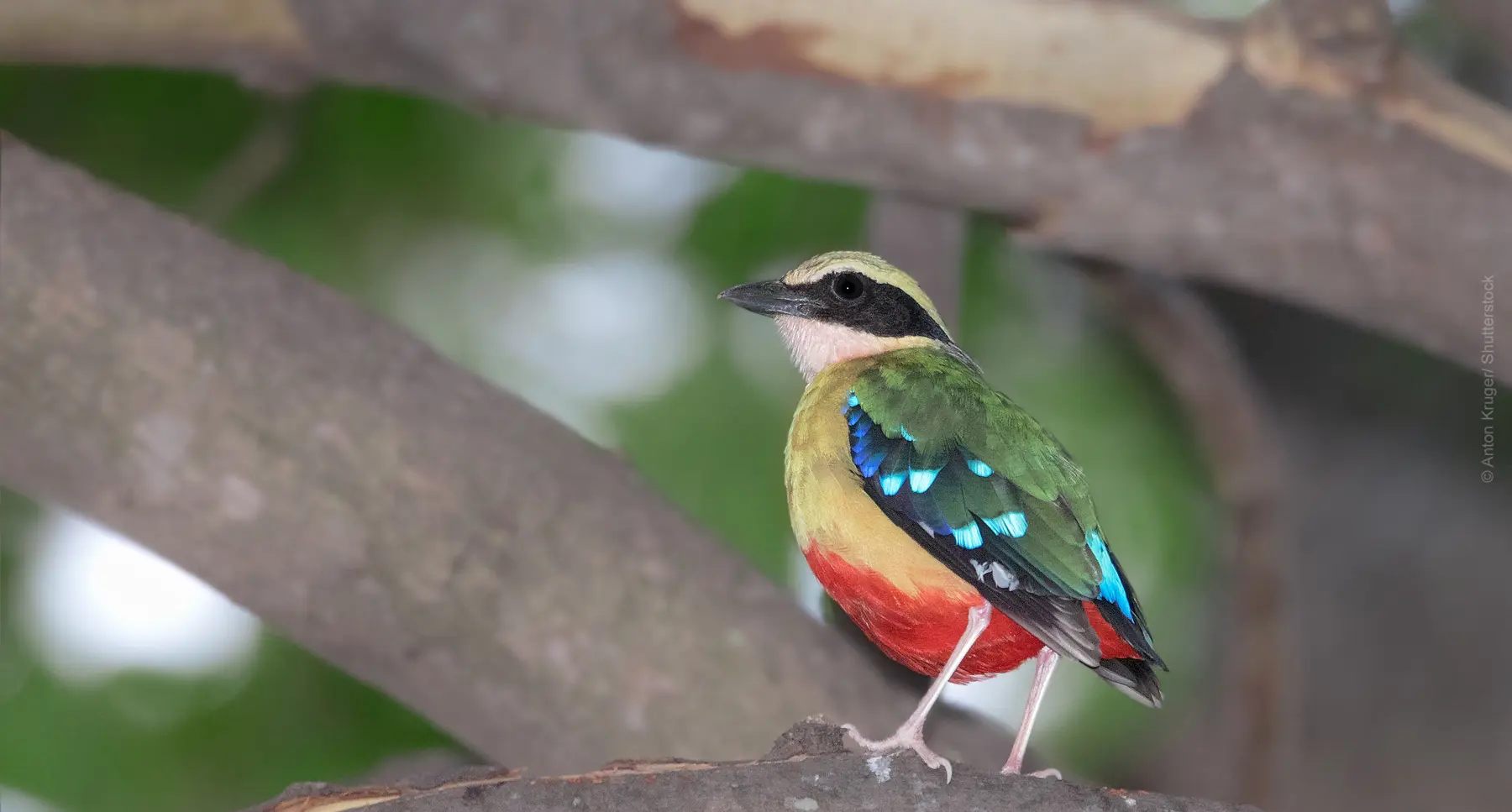
Although the African Pitta has bold vibrant coloured plumage it is a highly elusive species and very difficult to see in dark and often dense thickets and forest floors.
Both male and female plumage is striking and consists of an olive green back, mustard yellow breast, with a bright red coloured undertail and turquoise coloration on the tips of the tail and wing feathers. Their face markings are striking, consisting of yellow feathers and a thick solid black band covering the eye and ear coverts. Juveniles are similar in appearance but have duller colouration.
Behaviour
African Pitta’s are an extremely elusive species, given their preference for dense undergrowth habitats but also their shyness and propensity to hide. The African Pitta often remains motionless for long periods of time, then forages for invertebrates in quick bursts.
The African Pitta are is extremely territorial, birds will defend both breeding and foraging sites using explosive calls.
During the breeding season, dome-shaped nests are made from undergrowth materials high up within the upper branches of thorny tree species. A side entrance is created to enter and exit the nest, with a landing platform sometimes also being made.
Courtship displays consist of males bouncing in a dance-like display to attract females. On average, three eggs are laid between November and January – hatched chicks do not call for food but wait quietly and patiently.

Habitat
African Pitta’s are an extremely elusive species, given their preference for dense undergrowth habitats but also their shyness and propensity to hide. The African Pitta often remains motionless for long periods of time, then forages for invertebrates in quick bursts.
The African Pitta are is extremely territorial, birds will defend both breeding and foraging sites using explosive calls.
During the breeding season, dome-shaped nests are made from undergrowth materials high up within the upper branches of thorny tree species. A side entrance is created to enter and exit the nest, with a landing platform sometimes also being made.
Courtship displays consist of males bouncing in a dance-like display to attract females. On average, three eggs are laid between November and January – hatched chicks do not call for food but wait quietly and patiently.
Threats and Conservation
Deforestation and clearance of undergrowth due to agricultural expansion are threats to western and eastern populations of this species.
The population is believed to be declining, but due to the widespread range of the species, the IUCN currently classifies it as Least Concern.
Starting in 2021 and with support from WLT, Tanzanian conservation body TFCG will create 10 reserves to protect a stretch of coastal forests in the Lindi District, southeastern Tanzania, that is a known home of African Pitta.