Rivalling the Amazon rainforest for species richness, the Atlantic Forest is one of the world’s top biodiversity hotspots, and home to unique species found nowhere else. Once covering 150 million hectares across Brazil, Paraguay, and Argentina, the Atlantic Forest has been cleared to a tiny fraction of its original size, and what remains consists mostly of small, isolated fragments. With many species threatened with extinction, the Atlantic Forest is a global conservation priority.
To protect and restore the Atlantic Forest effectively, biological recording is essential. At the Guapiaçu Ecological Reserve, or REGUA, 50 km from Rio de Janeiro, decades of species recording and scientific research have revealed a rich biodiversity, including undescribed species, informing decisions on land management, reforestation and species reintroductions.
Part of this effort, my wife Rachel and I have now totalled almost a year at the reserve since joining the REGUA team in 2006. With many taxonomic groups remaining poorly documented, particularly invertebrates and fungi, last November, we returned for our eighteenth trip to seek out REGUA’s hidden species.
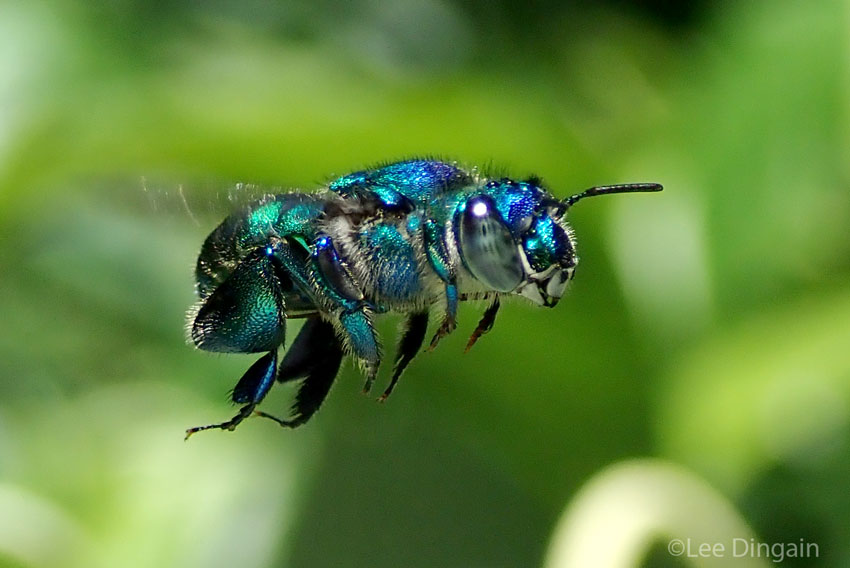
A male orchid bee of the genus Euglossa collecting scent at REGUA. Credit: Lee Dingain
Brilliant bees and flamboyant flies
November marks the start of the rainy season in south-east Brazil, though we arrived to find REGUA hot and dry. Beneath the forest canopy, it is stickily humid. Reaching a sunlit clearing, we set up our lure of cotton wool soaked in lavender and eucalyptus oils, and within minutes, metallic hovering jewels appear—orchid bees. Difficult to observe without chemical baits, males of this Neotropical tribe collect these fragrant oils just as enthusiastically as they do scents from flowers, fungi, decaying wood, tree wounds, fruits and even faeces, storing them in enlarged hollow hind legs for use during courtship displays. Two Euglossa species arrive, though neither can be identified beyond genus without microscopic examination.
Attracting our attention in the same shrub, picture-winged flies, tentatively identified as Megalaemyia punctulata, gather in leks on the leaves, displaying to one another by waving their strikingly patterned wings.
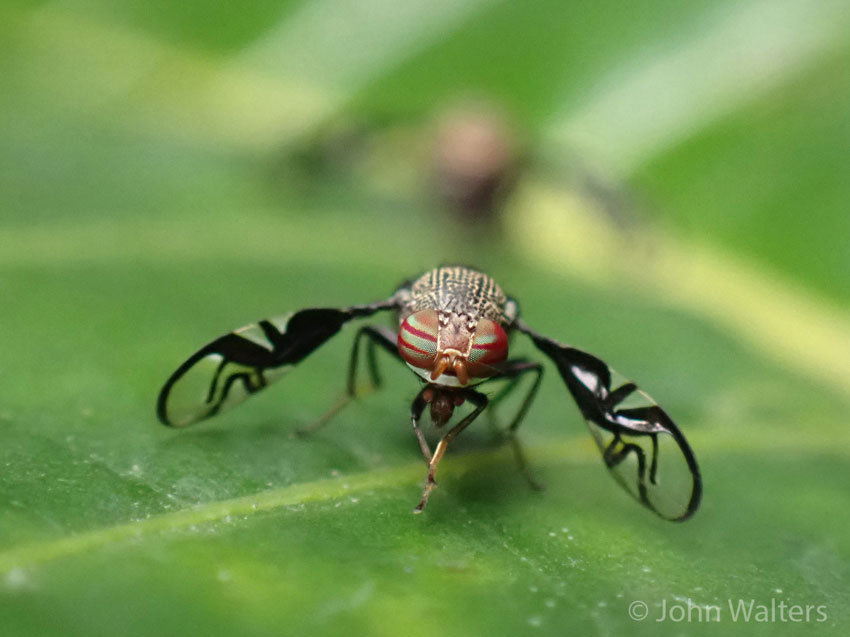
The Picture-winged fly, Megalaemyia punctulata, displaying at REGUA. Credit: John Walters
Forest floor oddities
In the leaf litter, we found some truly bizarre rainforest inhabitants. Despite their slug-like appearance, land flatworms, or planarians, are deadly predators, capturing any unfortunate invertebrate in their path, enveloping it in mucus and dissolving the tissues with powerful enzymes. Reaching 29 cm, the species below, Obama eudoximariae, is the largest in South America and a new one for REGUA.
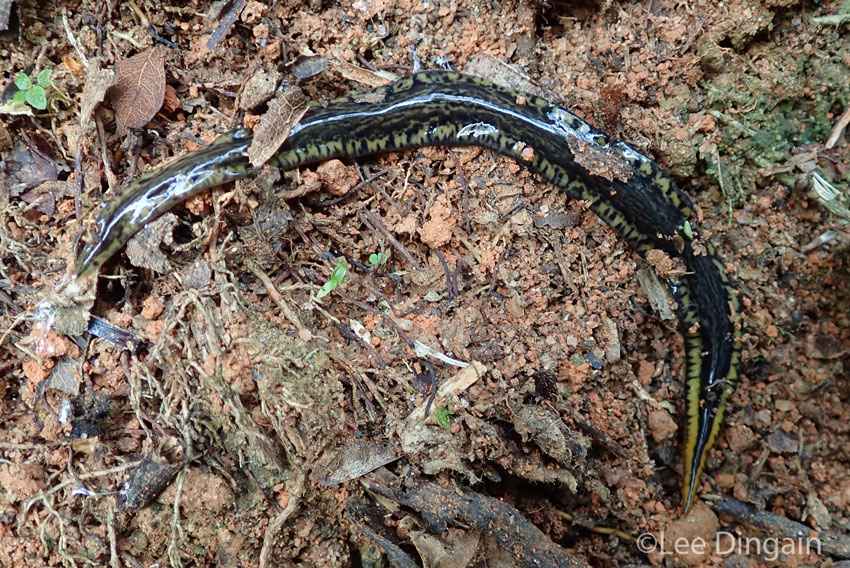
Obama eudoximariae, the largest land planarian in South America. Credit: Lee Dingain
Poking up through the leaf litter, the tiny, wire-like orange fruiting body of a fungus reveals a hidden and gruesome world of parasitism. Spores of Ophiocordyceps neonutans exclusively infect stink bugs. Digging carefully into the soil, we find the unfortunate host still attached to the erupting fungal stroma. New to REGUA, there are very few records of this recently described species anywhere.
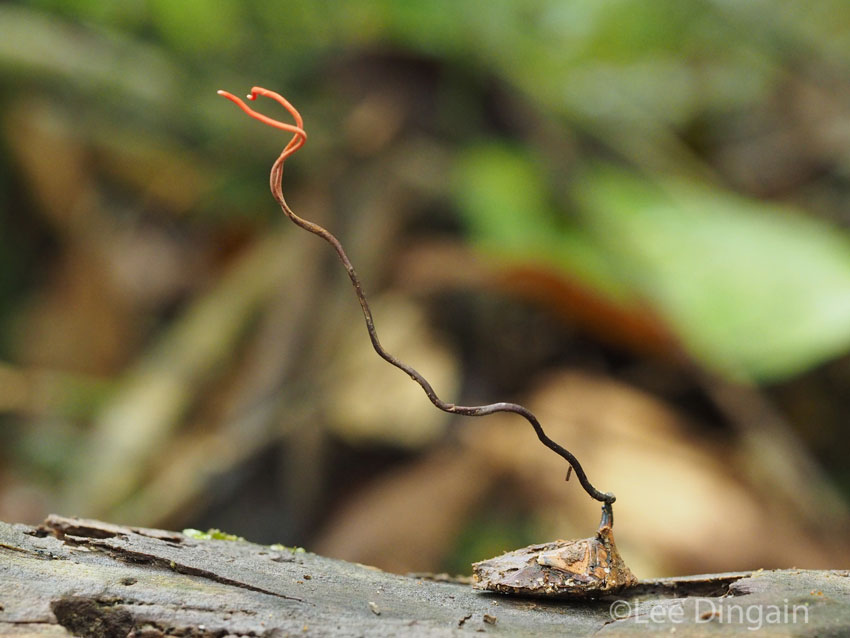
The parasitic fungus Ophiocordyceps neonutans and its stink bug host, REGUA. Credit: Lee Dingain
Ophiocordyceps fungi parasitise a variety of insects and arachnids, and even infect other fungi (false truffles). Astonishingly, as the fungus grows and consumes the host’s non-essential tissues, it takes control of the helpless victim’s behaviour to maximise its reproductive success. Found attached to a tree stump with the fruiting bodies of Ophiocordyceps curculionum, a beetle specialist, bursting from its exoskeleton, this aptly named pleasing fungus beetle (Megischyrus sp.) was impelled to climb half a metre above the forest floor so the fungus could better disperse its spores.
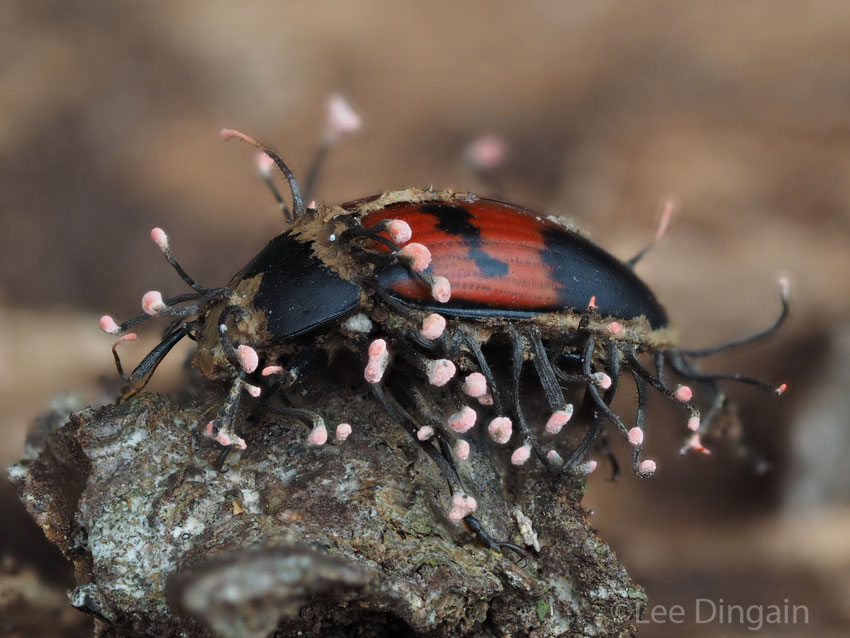
Ophiocordyceps curculionum erupting from a pleasing fungus beetle, REGUA. Credit: Lee Dingain
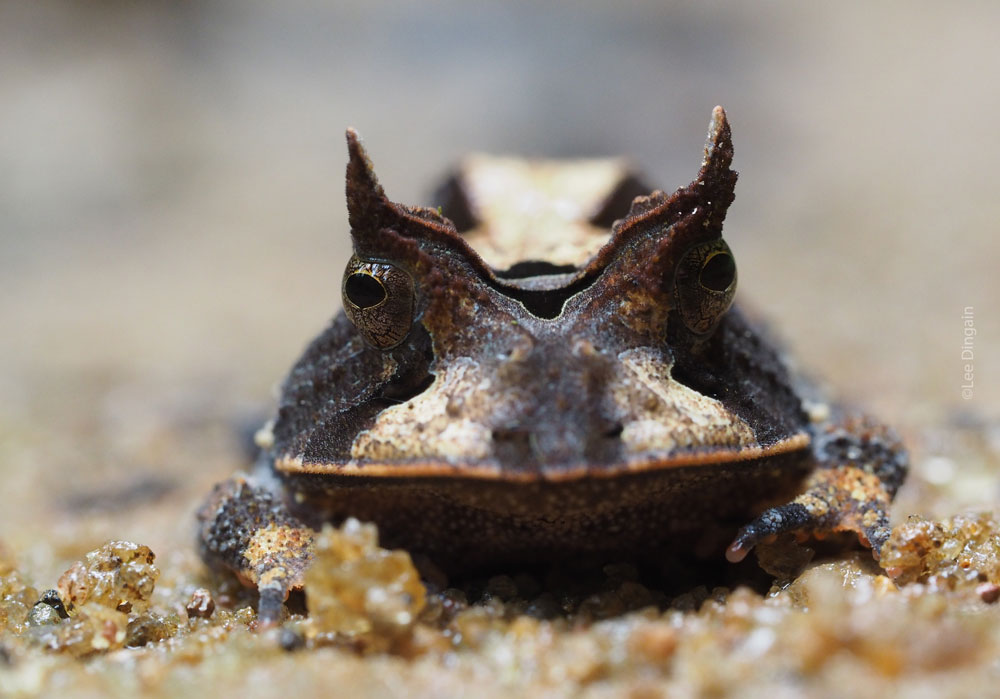
Continuing onward, a cryptic Bahia Smooth-horned Frog Proceratophrys boiei was so well camouflaged we didn’t notice it until it hopped just inches from our feet. Flattening its body and spreading its limbs, it froze in defence, virtually disappearing among the dead leaves. An ambush predator, the large mouth of this Atlantic Forest endemic can swallow beetles, orthopterans, spiders, and even frogs.
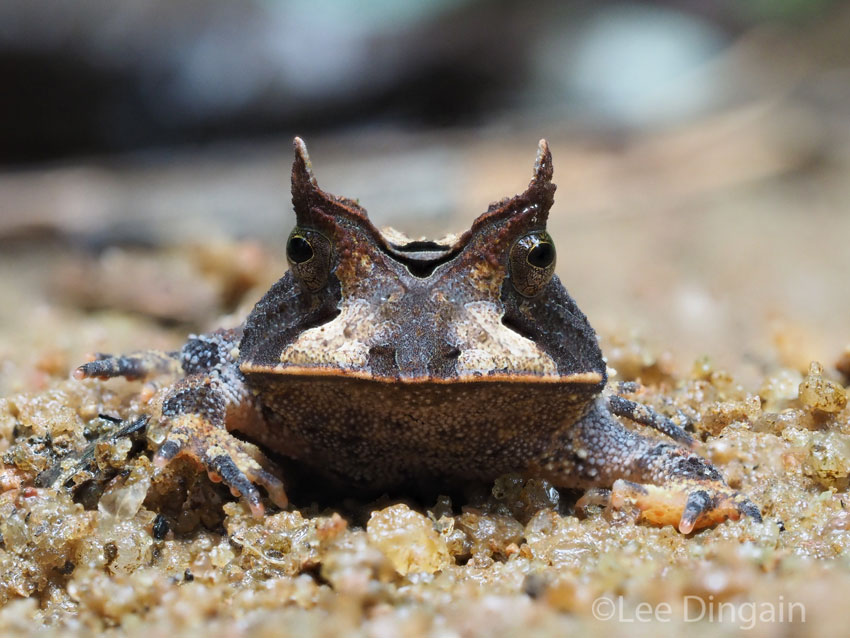
Bahia Smooth-horned Frog Proceratophrys boiei on the forest floor at REGUA. Credit: Lee Dingain
Widening the spectrum
At night, the Atlantic Forest really comes alive. Not only are many insects, amphibians, reptiles, mammals, and birds active only at night, but it is then that a poorly understood phenomenon can be best observed—biofluorescence.
Biofluorescent organisms absorb short-wavelength light and emit it at a longer wavelength, or colour, which many animals can see, but humans cannot without an ultraviolet (UV) or black light. Biofluorescence is widespread among animals, plants, and fungi, and UV lights have become valuable tools for night-time biological recording, enabling easy detection of many difficult-to-find species.
Setting off after dark, foliage appears red, and lichens, white in daylight, reflect red, blue, and yellow under UV light. Within minutes, we detect a scorpion glowing blue-green in the leaf litter—Tityus costatus, unique to Brazil’s Atlantic Forest, and the first documented at REGUA.
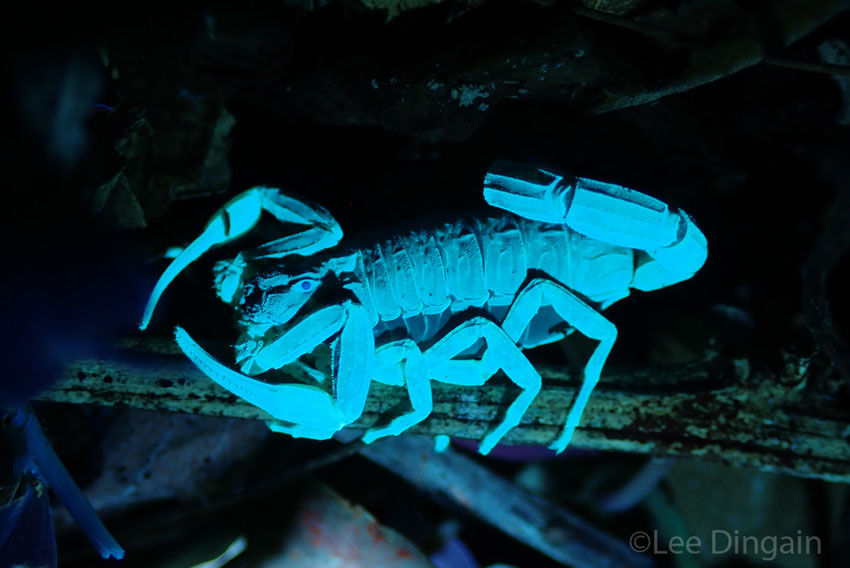
The scorpion Tityus costatus glowing under ultraviolet light at REGUA. Credit: Lee Dingain
Recent research suggests that nocturnal harvestmen use biofluorescence for species recognition under moonlight. We find several species, each exhibiting distinct biofluorescent patterns, such as this male Goniosoma varium, a large species also unique to the Atlantic Forest.
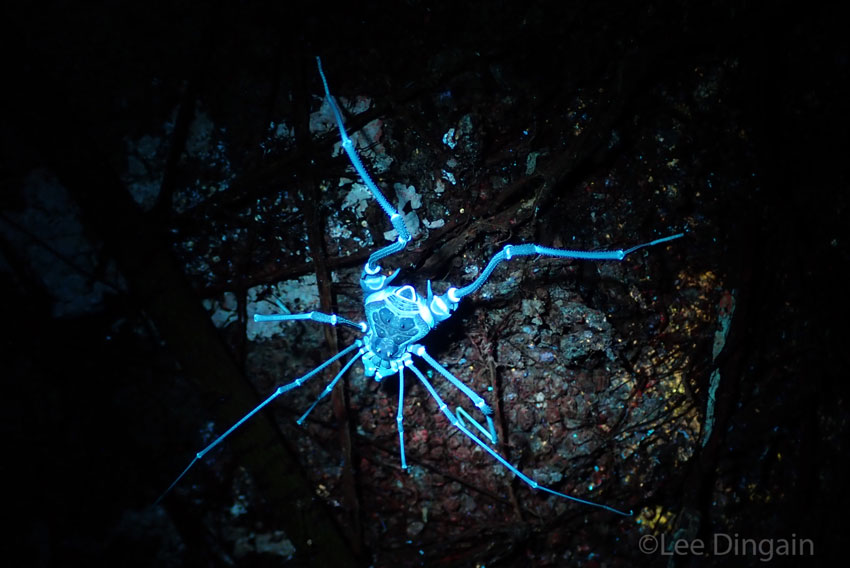
The harvestman Goniosoma varium at REGUA. Credit: Lee Dingain
Surprisingly, many camouflaged caterpillars, such as the Manduca hawkmoths, are also biofluorescent. Perhaps this is to deter predators, or maybe the reason remains to be discovered, like so many species yet to be recorded at REGUA.
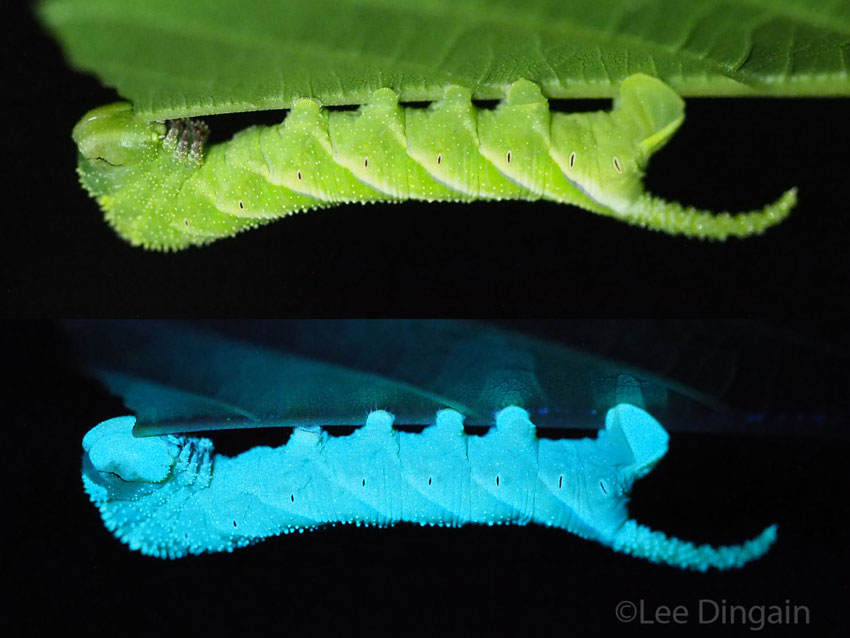
Hawkmoth caterpillar under white (top) and ultraviolet light at REGUA. Credit: Lee Dingain

 Help us raise £197,260 for our partner Reserva Ecológica de Guapiaçu (REGUA) to save 180 ha (444 acres) of vitally important land in Brazil’s Guapiaçu valley and protect the wildlife of the Guapiaçu watershed.
A generous private donor has provided funds which will match donations up to £197,260. This means gifts to the appeal will be doubled in value, and a £25 donation from you could be matched to make a £50 contribution overall. By donating, your support will go twice as far towards our fundraising target.